
The Science of Spellbinding Speech: An evening with David JP Phillips
"Every single decision you've ever taken in your entire life, and you will take for the rest of your life, is based on one thing and one thing only. And that is an emotion."
Some speakers inform, some entertain, and some leave you feeling like you’re not quite sure what just happened. David JP Phillips does all of these things and more - he literally transforms the room.
David doesn’t just take to a stage, and he doesn’t just ‘present’. He demonstrates. Every skill that he shared with us was used on the audience in real time, and the effect was both fascinating and slightly unnerving. By the end of the session, the room was louder, more open, and more energised. David had proved, beyond any doubt, that the science he's been studying for 25 years is not just theory.
The man behind the science
David JP Phillips is, on paper, a communications and storytelling expert. In practice, he’s more like a human behaviour scientist who happens to have some of the most-watched TEDx talks on the planet, with over 21 million views and counting. He has worked with some of the world's most recognisable organisations: Coca-Cola, IKEA, Disney, Oracle, Google, and Tesla, to name a few. David’s book, High on Life, instructs us how to harness the body’s natural chemical reactions to create certain states to change our mindset.
He spent two days in Switzerland shortly before our meeting, helping a shoe brand build a story around a single product. He is, in short, someone whose methodology has been tested at the very highest level.
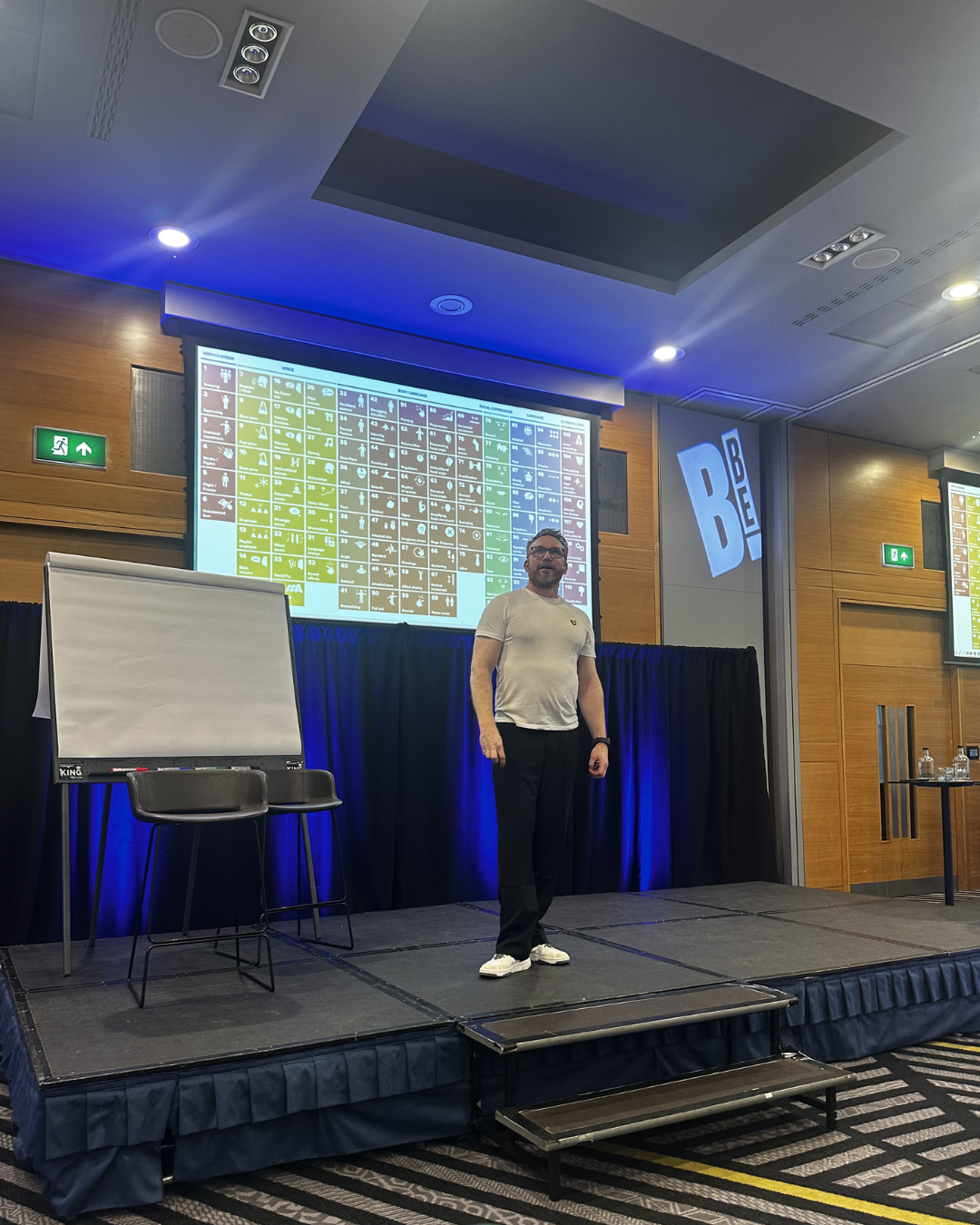
From the moment David opened his mouth, it was clear this wasn't going to be a conventional talk. David's approach to public speaking, communication and presentation has been built from the ground up; not through instinct, nor inherited wisdom, but through data. For several years, he sat in front of a spreadsheet and recorded every communication skill he observed in every person he studied, until he couldn't find any more. He ended up with 236, but eventually whittled them down to 110.
"I simply sat in Excel," said David. "And for every person I saw, I wrote down the skills I could see them use. I just carried on filling out this list year after year after year."
One skill that changes twenty
Central to David's framework is the idea of the ‘mother skill’; a behaviour so foundational that mastering it automatically improves up to twenty other things at once. The science behind this is the somatic feedback loop: when you use your body deliberately, your voluntary nervous system feeds back into your autonomic nervous system, and suddenly your voice, your face, your energy, your presence all shift along with it.
He demonstrated this with an exercise that I won't forget in a hurry. The audience was asked to teach a physical activity to a partner, but with their hands completely restricted. The exercise was repeated, this time with full use of gestures, movement and body language. Nobody was told to speak louder, use more facial expression, or change their tone, but all of those things happened anyway.
"Did I ask you to increase the volume of your voice?” he asked. “Nowhere. Did I ask you to use your facial expressions? No. Did I ask you to change your tonality? No. Did you? Yes. There were up to 20 different variables. A change just by you using your hands."
David’s practical tip for content creators is: before you record a video, pre-plan three deliberate gestures. Your brain will apparently invent three more on its own. Start the engine, and it runs itself.
What your body is saying without you
David has a gift for making you acutely self-conscious in the best possible way. He broke down the unconscious body language habits that give us away in presentations and pitches, such as the ‘fig leaf’, the folded arms, the ‘double bunny’, the ‘forklift’, and the ‘peacock’; each one a form of blocked or protective posture that signals insecurity to the person in front of you, precisely at the moments you most need to appear confident.
David said that he coached a political party leader who discovered - only when David pointed it out on video - that he flapped his elbows every single time he felt vulnerable in a negotiation. He had no idea he was doing it. That is the nature of these habits: they are entirely invisible to us, but others can see them.
The head tilt is one of his favourite examples of a skill that can be used with intention. A slight tilt left or right increases the sense of empathy and care in the person watching you; it signals that you are genuinely listening. But when you need to be assertive, or when something important needs to land, a straight head is essential.
David says: "When you want to be firm, you don't want to be tilting your head at the same time." The distinction, when demonstrated live, was startling.
Movement matters too. Every step that a speaker takes towards their audience stimulates something very primitive in the watching brain; attention rises automatically, and there is nothing the audience can do about it. The effect, watching it play out, was exactly as described: hypnotic.
The sound of confidence
David made what felt like his most important point of the day when he spoke about voice. Filler sounds, i.e., the ‘um’, the ‘uh’, the barely-audible exhale that bridges our sentences, are, he argued, the single most damaging communication habit most of us carry. Not because they sound unprofessional, but because of what they signal. Filler sounds appear when we are nervous, unprepared, uncertain, or not being entirely truthful. A listener can't identify which of those it is, but they register the doubt all the same. He said:
"A person who does not have filler sounds is literally constantly perceived as confident. Well-read up. They know what they're thinking about."
David assured us that the fix is simple, but requires practice - replace the exhale with a quiet inhale. Don't try to remove the habit, but instead replace it. Four weeks of consistent effort should eliminate 90-95% of filler sounds. The goal is not to become robotic, because the odd filler sound makes a speaker seem human and present. The goal is to stop letting them run the show.
Pace, too, is a form of communication that most of us misuse. We tend to speed up when we are least confident, rushing through the parts of our pitch we are least sure about, which has exactly the wrong effect. Slowing your pace signals that what is being said now is important. It holds attention and creates the space for an idea to land. And crucially, pauses feel far longer to the speaker than they do to the audience. David's advice is to hold the silence until the discomfort becomes almost unbearable, which is apparently roughly where it needs to be.
The demonstration that said everything
David closed his session by proving, one final time, that what the body communicates overrides what the mouth is speaking. So he delivered a warm, generous, appreciative close to the session — while using negative, dismissive, closed body language throughout.
The result was deeply disconcerting, because our brains ignored the words entirely. We could hear the kindness, but we felt only the distance. It was a perfect, slightly unsettling demonstration of his central argument: that delivery is not secondary to content.

Key takeaways for entrepreneurs
Use your hands: Functional gestures trigger the somatic feedback loop, so pre-plan three gestures before any recording or presentation, and your brain will generate more automatically.
Check your body language on video: Blocked postures - crossed arms, fig leaf, hands clasped - appear exactly when you feel most vulnerable, which is when you least need to signal it.
Volume is a mother skill: Increase your baseline volume by 20–30%, and your posture, tonality and confidence will follow without you having to think about it.
Eliminate filler sounds: Replace the ‘um’ with a quiet inhale. Four weeks of consistent practice will remove the habit almost entirely.
Slow down for the important parts: Pace controls where your audience places their attention, so don't rush through the things you most need them to hear.
The pause is your friend: It feels far longer to you than it does to the room. Hold it until it's uncomfortable; that's exactly where it should be.
